
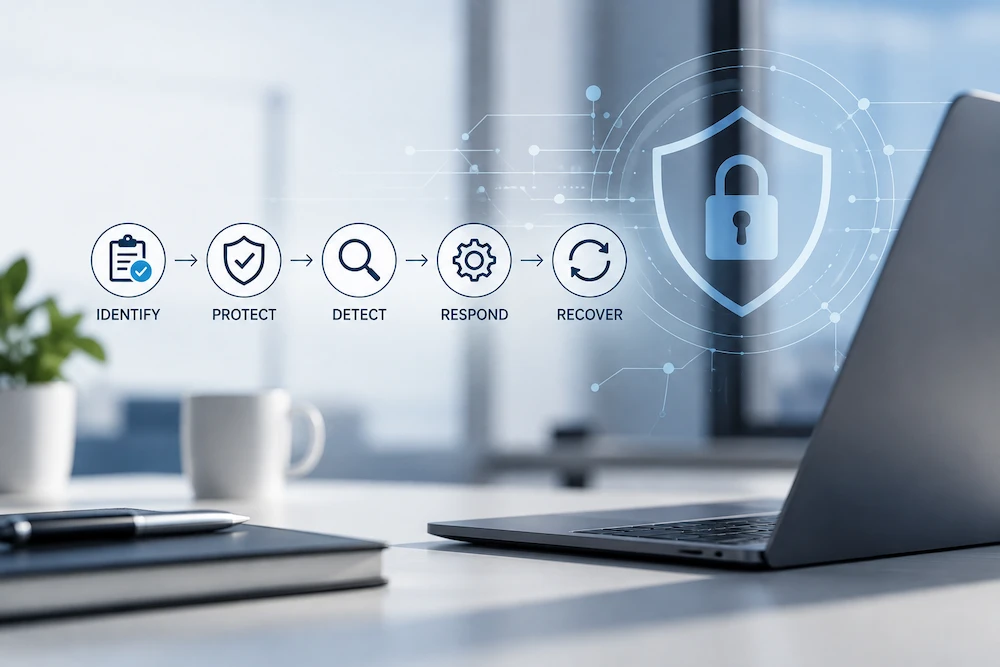
Cybersecurity is usually presented as a technology problem.
Firewalls. Endpoint protection. Encryption. Vulnerability scanners. Security monitoring. Access controls. Incident response.
All of those things matter. But underneath the technology is something much more familiar to anyone who has worked with Lean Six Sigma.
Cybersecurity is also about understanding how a system works, identifying where it can fail, assessing the consequences, putting controls in place, monitoring performance, responding when something goes wrong, recovering from failures, and continuously improving the process.
In other words, a surprisingly large part of modern cybersecurity looks a lot like process improvement.
Cybersecurity Is Not Just About Stopping Attacks
It is tempting to think of cybersecurity as a simple objective: keep attackers out.
That is obviously important, but it is not enough.
Modern organizations have too many systems, users, suppliers, applications, cloud services, devices, integrations, and dependencies to assume that every possible failure can be prevented.
A good cybersecurity program therefore has to answer a much broader set of questions.
What assets are important? What could go wrong? What would happen if something failed? Which risks can be reduced? How will we know when something unusual happens? What should happen when an incident is detected? How quickly can the organization recover? And what should change afterward so the same problem is less likely to happen again?
Those are not exclusively cybersecurity questions.
They are process questions.
The Same Logic Appears in Lean Six Sigma
Lean Six Sigma is fundamentally concerned with understanding processes and reducing the variation, waste, defects, and risks that prevent those processes from producing the intended result.
That does not mean cybersecurity "is" Lean Six Sigma, or that cybersecurity frameworks were simply copied from Lean Six Sigma. The disciplines developed for different purposes.
But many of the methods used in cybersecurity follow the same underlying logic.
Understand the current state. Identify risks and potential failure modes. Establish controls. Monitor the process. Detect abnormal conditions. Respond when something goes wrong. Recover the process. Learn from what happened. Improve the system.
Once you look at cybersecurity through that lens, the connection becomes difficult to miss.
Identify: Understand What You Are Actually Protecting
You cannot meaningfully protect a process you do not understand.
The first question is therefore not necessarily "Which security product should we buy?"
It is "What do we actually have?"
Organizations need to understand their important systems, data, processes, users, dependencies, suppliers, and technology. They also need to understand what would happen if one of those things became unavailable, compromised, or unreliable.
This is very similar to the early stages of a Lean Six Sigma project.
Before improving a process, you need to understand the process. Before reducing risk, you need to understand what creates the risk.
A process map can reveal how information moves between people and systems. A value stream perspective can reveal where information waits or depends on another process. A SIPOC can establish the boundaries and major participants. Data can show where problems actually occur rather than where people assume they occur.
The terminology may be different, but the discipline is familiar.
Prevent: Build Controls Before Something Goes Wrong
Once the important assets, processes, and risks are understood, the next logical question is what can be done to prevent problems from occurring.
This is where cybersecurity uses layers of controls.
Access restrictions can prevent unauthorized users from reaching systems. Authentication controls can make unauthorized access more difficult. Software updates can address known vulnerabilities. Network segmentation can limit how far a compromise can spread. Secure development practices can reduce the likelihood that vulnerabilities are introduced in the first place.
This is very similar to the Lean Six Sigma concept of designing quality into a process rather than relying entirely on inspection after the fact.
A Poka-Yoke prevents an error from being made or makes the error immediately obvious. A cybersecurity control can perform a similar function by preventing an unsafe action or restricting what a user or system is allowed to do.
The principle is straightforward:
If you can prevent the failure from occurring, prevention is usually preferable to discovering the failure later.
But cybersecurity also recognizes something important that Lean Six Sigma practitioners know well: not every failure can be prevented.
FMEA Thinking: What Happens When Prevention Fails?
This is where the connection to Failure Mode and Effects Analysis becomes particularly strong.
An FMEA does not ask only, "How do we prevent this failure?"
It asks what could fail, what the effect would be, what could cause it, what controls already exist, and what additional actions might be appropriate.
Cybersecurity operates with essentially the same mindset.
What happens if an account is compromised? What happens if malware reaches a workstation? What happens if a supplier's system is breached? What happens if a critical service becomes unavailable? What happens if a backup cannot be restored?
The objective is not to pretend that these events can never happen.
It is to understand the consequences well enough to prepare for them.
This is one reason cybersecurity can be a useful real-world example of the principle behind FMEA: good process design prepares for failure rather than assuming failure is impossible.
Detect: Know When the Process Has Changed
Even strong preventive controls will not catch everything.
That makes detection critical.
Cybersecurity systems continuously look for signs that something unusual is happening. An account may suddenly log in from an unexpected location. A system may begin making an unusual number of requests. A device may start communicating with a destination it has never contacted before. A normally quiet server may suddenly generate a large volume of traffic.
The important idea is not simply collecting more data.
It is distinguishing normal behavior from signals that indicate something has changed.
That is very close to the logic behind Statistical Process Control.
A control chart is not useful because it produces a graph. It is useful because it helps distinguish normal process variation from signals that may indicate something unusual has happened.
Cybersecurity monitoring applies a similar principle to a different type of process.
The question becomes:
Is this behavior within the expected operating range, or is something different happening?
Respond: Have a Process for When Something Goes Wrong
Detecting a problem is only useful if the organization knows what to do next.
An alert that sits in a dashboard while nobody knows who should act on it is not a particularly effective control.
Cybersecurity therefore places significant emphasis on incident response. When a security event is detected, there should be defined actions for investigating it, containing the impact, communicating with the appropriate people, and taking steps to prevent the situation from becoming worse.
Again, this is fundamentally process design.
Who is responsible? What happens first? What information is needed? What decisions have to be made? When should the issue be escalated? Which actions can be automated? Which actions require human judgment?
Those are exactly the kinds of questions you would ask when designing a robust operational process.
A response process should not depend entirely on somebody remembering what to do in the middle of a crisis. The more predictable the response can be made in advance, the less the organization has to improvise when the pressure is highest.
Recover: Getting the Process Back to Normal
Responding to an incident is not the same thing as recovering from it.
A compromised system may have been isolated, but the business still needs to operate. A service may have been taken offline, but customers still need access. Data may have been protected from further damage, but the organization may still need to restore systems and verify that they are safe to return to service.
Recovery therefore needs its own process.
Backups need to exist and be usable. Recovery procedures need to be understood. Responsibilities need to be clear. Systems need to be restored in an appropriate order. The organization needs to know when normal operations have actually resumed.
This is another place where process maturity matters.
Having a backup is not the same as having a recovery process. Having a recovery document is not the same as knowing that the recovery process actually works.
In Lean Six Sigma terms, the control needs to be capable of producing the intended result when it is actually needed.
Then Comes the Part Lean Six Sigma Knows Very Well: Learn and Improve
The process should not simply return to normal and forget what happened.
A security incident provides information about how the system actually behaved under stress.
Maybe an alert was generated but nobody noticed it quickly enough. Maybe the escalation path was unclear. Maybe a backup existed but took much longer to restore than expected. Maybe an employee followed the documented process but the process itself contained a gap.
Each of those findings is an improvement opportunity.
This is where the cybersecurity cycle starts looking remarkably familiar again.
Something happened. The organization collected evidence. It analyzed what happened. It identified weaknesses. It implemented changes. It monitored the result.
That is continuous improvement.
The same principle applies after a successful incident response as after any other process failure: the event should make the process better, not simply return it to exactly the way it was before.
ISO 27001 Takes the Same Thinking Into a Management System
The connection becomes even more interesting when you look at ISO/IEC 27001.
ISO/IEC 27001 is not simply a checklist of cybersecurity technologies. It defines requirements for an Information Security Management System, or ISMS, and provides a framework for establishing, implementing, maintaining, and continually improving that system.
That requires organizations to think systematically about information security rather than treating security as a collection of disconnected technical controls.
There are policies and procedures. There are defined responsibilities. There is risk assessment. There are controls. There is documented information. There is monitoring and evaluation. There are audits. There are corrective actions. And there is continual improvement.
That should sound familiar to anyone who has worked with a mature Lean Six Sigma management system.
The objectives are different. ISO 27001 is concerned with information security, while Lean Six Sigma is concerned with improving processes and performance. But the management disciplines overlap significantly: understand the current state, assess risk, establish controlled processes, measure performance, identify problems, take corrective action, and improve the system over time.
ISO 27001 therefore provides a useful example of how process discipline can become part of an organization's normal operating system rather than remaining a one-time improvement project.
Documentation Is Part of the Process, Not Bureaucracy for Its Own Sake
One of the areas where people sometimes misunderstand ISO 27001 is documentation.
Documentation can look like administrative overhead when viewed in isolation.
But documentation serves an important process purpose.
If a critical process exists only in someone's head, the organization cannot easily demonstrate how it is supposed to work, determine whether people are following the same method, identify changes, or reliably transfer responsibility when someone leaves.
A documented process creates a reference point.
Once that reference point exists, the organization can ask better questions. Is the process actually being followed? Does it produce the intended result? Where does it fail? Has the process changed? Are the controls still appropriate?
This is very close to the Lean Six Sigma idea of Standard Work.
Standard Work does not exist simply so somebody can put a procedure in a document repository. It establishes the current agreed method so that deviations can be understood and improvements can be made deliberately rather than through uncontrolled variation.
Risk Management Is Another Shared Principle
Lean Six Sigma practitioners are accustomed to thinking about risk.
FMEA asks what could go wrong and what the consequences might be. Process analysis identifies where defects or failures can occur. Control plans define how important process characteristics will be monitored. Improvement teams prioritize effort based on the significance of the problem and the evidence available.
Information security does the same thing with a different category of risk.
An organization cannot eliminate every possible cybersecurity threat. It has to understand which risks matter, determine what controls are appropriate, and decide where resources should be invested.
That is not fundamentally different from any other risk-based improvement decision.
The question is not "Can something go wrong?"
Almost anything can go wrong.
The useful questions are:
What could go wrong? How serious would it be? How likely is it? How would we know? What controls do we have? What happens if those controls fail? And what level of risk are we prepared to accept?
The Frameworks Are Different. The Thinking Is Familiar.
It would be misleading to suggest that NIST or ISO 27001 are simply Lean Six Sigma frameworks with different terminology.
They are not.
NIST's Cybersecurity Framework 2.0 currently organizes cybersecurity outcomes around six Functions: Govern, Identify, Protect, Detect, Respond, and Recover. The Functions are intended to work together as part of an organization's ongoing approach to managing cybersecurity risk.
What makes the comparison interesting is the underlying management logic.
Identify the system and its risks. Establish controls. Detect when the process behaves differently from what is expected. Respond when something goes wrong. Recover from the resulting disruption. Learn from what happened. Improve the process.
That is a very familiar way of thinking to anyone who has worked seriously with Lean Six Sigma.
Where Cybersecurity and Lean Six Sigma Meet
The connection becomes clearer when the ideas are placed side by side.
| Cybersecurity Practice | Lean Six Sigma Parallel |
|---|---|
| Understand assets, systems, and dependencies | Understand and map the process |
| Identify cybersecurity risks | Identify process risks and potential failure modes |
| Implement security controls | Prevent defects and control process conditions |
| Monitor for anomalies | Monitor process performance and variation |
| Detect security incidents | Detect abnormal process behavior or defects |
| Incident response | Containment and corrective action |
| System recovery | Process recovery and restoration of normal operation |
| Lessons learned | Continuous improvement |
The terminology is different because the problems are different. The underlying discipline is remarkably similar.
The Bigger Lesson for Process Improvement
There is a useful lesson here for organizations that have never considered Lean Six Sigma outside traditional manufacturing or quality environments.
Modern cybersecurity teams are solving process problems every day.
They map dependencies. They assess risks. They design controls. They monitor performance. They investigate abnormal conditions. They standardize responses. They automate repetitive actions. They recover from failures. They conduct reviews after incidents. And they continually improve the system.
None of that requires a factory floor.
The same logic can be applied to customer support, software development, finance, healthcare, hospitality, logistics, administration, compliance, and almost any other environment where work moves through a process.
This is one of the reasons Lean Six Sigma remains useful in a technology-driven organization. The tools may change, but the underlying problem remains the same: how do you design a process that produces the intended result reliably, detect when it does not, and improve it when you learn something new?
Could Cybersecurity and Data Protection Professionals Benefit From Lean Six Sigma Training?
Absolutely.
You do not need to work in manufacturing or traditional quality management to benefit from Lean Six Sigma. If your work involves processes, risk, data, controls, investigation, compliance, or continuous improvement, the way of thinking behind Lean Six Sigma can transfer directly into your day-to-day work.
Cybersecurity and data protection professionals already spend much of their time thinking about how processes can fail, how risks can be reduced, how problems can be detected, and how organizations should respond when something goes wrong. Lean Six Sigma provides a structured way to approach those questions using data, process analysis, root cause analysis, risk assessment, measurement, and continuous improvement.
More importantly, Lean Six Sigma training can change the way you look at problems.
Instead of immediately asking, "What should we fix?", you start asking, "What is actually happening?" Instead of assuming that the most obvious explanation is the correct one, you look for evidence. Instead of treating every failure as an isolated incident, you start looking for patterns in the process that produced it.
That thought process can transfer into almost any professional environment.
A cybersecurity professional investigating repeated security incidents, a data protection professional reviewing a privacy process, or a compliance professional dealing with recurring findings can all apply the same fundamental discipline: understand the process, identify the possible causes, use evidence to determine what is actually happening, and then make a deliberate decision about what to change.
You may never use a Lean Six Sigma tool with its traditional manufacturing terminology. You may not even realize that you are applying Lean Six Sigma thinking. But the mindset stays with you.
That is one of the most valuable things Lean Six Sigma training can provide: not just a collection of tools, but a different way of looking at problems.
If your role involves cybersecurity, data protection, compliance, technology, operations, or risk management, that way of thinking can become another useful part of your professional toolkit. Our Lean Six Sigma certification courses are designed around practical application, helping you learn not just what the tools are, but how to think through real problems and choose the right approach for the situation.
Where the Concept Ends and the Real Skill Begins
Recognizing the connection between cybersecurity and Lean Six Sigma is useful. Applying either discipline properly is another matter.
A cybersecurity framework does not make an organization secure simply because the framework exists. Likewise, having a Lean Six Sigma toolbox does not automatically improve a process.
The real skill is knowing how to apply the right method to the right problem.
That means understanding the process, collecting meaningful data, assessing risk, distinguishing signals from normal variation, designing appropriate controls, validating that those controls actually work, and improving the system when evidence shows that something needs to change.
Cybersecurity has built a sophisticated discipline around those ideas because the consequences of process failure can be severe.
Lean Six Sigma provides another way of looking at the same fundamental challenge.
Build the process to prevent what you reasonably can. Detect what still happens. Respond deliberately. Recover reliably. Then use what you learned to make the process better.
That is not exclusively a cybersecurity idea.
It is good process management.
Whether you work in cybersecurity, data protection, technology, finance, hospitality, healthcare, or operations, the ability to look at a problem differently can be one of the most valuable skills you take away from Lean Six Sigma training.
The tools are useful. The mindset is transferable.
Our Lean Six Sigma certification courses focus on both, giving practitioners the knowledge and practical experience to apply structured improvement thinking to the problems they actually face at work.
Frequently Asked Questions
1. Is cybersecurity actually based on Lean Six Sigma?
No. Cybersecurity frameworks and Lean Six Sigma developed for different purposes and should not be treated as the same methodology. The connection is that many cybersecurity practices use principles that are familiar from Lean Six Sigma, including risk identification, process control, monitoring, failure response, recovery, and continuous improvement.
2. How is cybersecurity similar to Lean Six Sigma?
Both disciplines emphasize understanding how a system works, identifying potential problems, controlling risk, monitoring performance, investigating failures, implementing corrective actions, and improving the process over time. The specific tools and objectives differ, but the underlying problem-solving discipline has significant overlap.
3. How does FMEA relate to cybersecurity?
FMEA proactively identifies potential failure modes, their causes, their effects, and the controls that can reduce their risk. Cybersecurity uses similar thinking when organizations consider what could go wrong, what the consequences would be, how the event could be detected, and what response and recovery capabilities should be prepared in advance.
4. What does ISO 27001 have to do with Lean Six Sigma?
ISO/IEC 27001 defines requirements for an Information Security Management System that is established, implemented, maintained, and continually improved. Its emphasis on documented processes, risk management, controls, monitoring, corrective action, and continual improvement overlaps significantly with the process-management principles used in Lean Six Sigma.
5. Is ISO 27001 just a cybersecurity checklist?
No. ISO/IEC 27001 is a management-system standard. Its purpose is to establish a systematic approach to managing information security rather than simply requiring a collection of individual technical products or controls.
6. Why is recovery important if the goal is to prevent cybersecurity incidents?
Because prevention cannot eliminate every possible failure. A resilient process assumes that some events may still occur and prepares to detect, contain, respond to, and recover from them. Recovery reduces the operational impact when prevention and other controls are not enough.
7. What can Lean Six Sigma practitioners learn from cybersecurity?
Cybersecurity provides a useful example of designing processes around failure as well as normal operation. It demonstrates the value of layered controls, proactive risk assessment, continuous monitoring, predefined response processes, automated recovery where appropriate, and using lessons learned to improve the system after an incident.
8. Could cybersecurity and data protection professionals benefit from Lean Six Sigma training?
Absolutely. Cybersecurity and data protection involve many of the same underlying challenges that Lean Six Sigma addresses: understanding processes, identifying risks, investigating problems, analyzing data, establishing controls, reducing variation, and continually improving how work is performed. The problem-solving mindset developed through Lean Six Sigma training can transfer directly into these environments, even when the specific tools or terminology are different.
9. Do I need to work in manufacturing to use Lean Six Sigma?
No. Lean Six Sigma can be applied anywhere work moves through a process and produces an outcome. Cybersecurity, data protection, software development, finance, healthcare, hospitality, customer service, logistics, and administrative processes can all benefit from the same structured approach to understanding problems, using data, managing risk, and improving processes.