
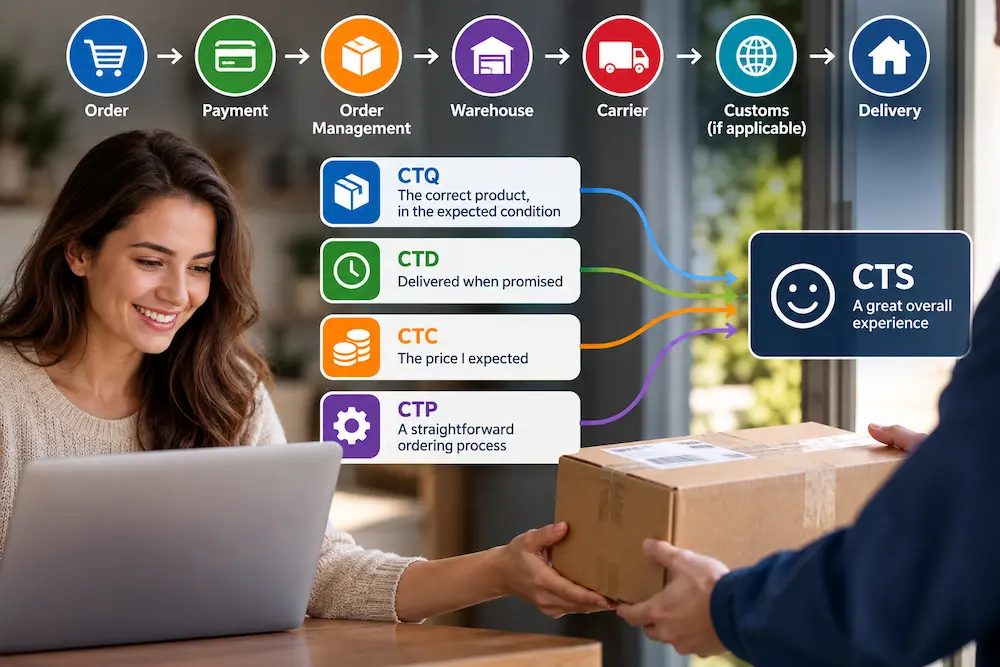
A customer places an order on an ecommerce website. The product is in stock, the price looks right, payment goes through, and the confirmation email arrives almost immediately. From the customer's perspective, it feels like one simple transaction. Behind that transaction, however, several different processes and systems have to work correctly for the order to become a successful delivery.
The order has to move from the ecommerce system into the payment process, then into the order or warehouse system. The correct product has to be picked and packed, the shipment has to be passed to the carrier, the address and other required information have to arrive correctly, and an international order may have to pass through customs before it reaches the customer. The customer doesn't see most of those handoffs. They simply expect the order to arrive correctly, on time, and for the price they were promised.
That is where CTX becomes useful. The customer has an overall expectation of what a successful experience looks like, but that expectation is made up of different dimensions. The product, the timing, the cost, the ordering process, the delivery experience, and the final level of satisfaction are related, but they are not all the same thing.
One Word Was Never Going to Cover This
Most people, once they've learned even a little about process improvement, reach for one term whenever a customer cares about something: Critical to Quality, or CTQ. It's the most familiar label in the whole vocabulary, so it is easy to use it for almost everything. But an ecommerce order makes the problem obvious. The customer isn't only concerned with whether the product itself is good.
The customer wants the correct product. That is a quality requirement. They want it delivered when promised. That is a delivery requirement. They expect the total price to match what was communicated. That is a cost requirement. They expect checkout to be understandable and reasonably easy to complete. That is a process requirement. And at the end of all of it, they expect the overall experience to meet their expectations. That is where customer satisfaction comes in.
This is what CTX provides: an umbrella over the different things that can be critical to the customer, including Critical to Quality, Critical to Delivery, Critical to Cost, Critical to Process, Critical to Satisfaction, and other dimensions where a business genuinely needs to make a distinction. CTQ is one important member of that family. It is not the entire customer requirement.
Why the Specific Label Actually Changes the Fix
Naming the correct dimension isn't just a filing exercise. It helps clarify what actually has to work and where a problem may have originated. A customer who receives the wrong product has a different problem from a customer who receives the right product three days late, even though both may describe the experience simply as "my order went wrong."
Consider the checkout stage. The customer enters a shipping address. The process needs to capture that address accurately enough for the order to be delivered to the intended destination. At the same time, the customer needs to be able to enter the address without unnecessary difficulty. The requirement therefore has implications for delivery as well as the process itself. The customer doesn't need to know which system stores the address or how it is passed downstream. They simply expect the information to be correct when it is needed later.
The same thing happens after checkout. Payment needs to complete, the order needs to move into the appropriate fulfillment process, the warehouse needs the information it needs to pick the correct item, and the carrier needs the information required to deliver it. An international shipment may introduce another handoff through customs. Each individual step may have its own requirements, but they ultimately contribute to the customer's overall outcome.
This is why CTX is more useful than simply calling everything CTQ. The customer sees one journey. The business has a chain of processes, systems, handoffs, and requirements supporting that journey.
How This Connects to Something Already Familiar
A customer requirement only becomes useful when you understand exactly what the customer is expecting and what has to happen for that expectation to be met. "Delivered by Friday" is different from "the correct product arrives without damage." One is primarily about delivery. The other is about the quality of the outcome. Treating them as one generic requirement makes it much harder to understand what the process actually needs to deliver.
The same distinction matters when something goes wrong. If a customer says an order is late, that tells you what the customer experienced. It does not automatically tell you why it happened. The cause could be somewhere in order processing, fulfillment, shipping, an information handoff, or another part of the process. Separating the symptom from the actual cause is a critical part of understanding what needs to change.
The Habit Worth Building
In practice, this comes down to a useful question worth asking whenever a customer requirement, complaint, or piece of feedback comes in: which specific thing is this actually critical to? Is it the product itself? The timing? The cost? The process the customer has to go through? Or the customer's overall satisfaction with the experience?
The answer is not always obvious from the customer's words. "My order was terrible" could mean the wrong product arrived, the product arrived damaged, the order was late, the price was different from what was expected, or the customer had difficulty getting help. Those are very different problems hiding behind the same general complaint.
Where This Turns Into a Deeper Skill
Following one customer journey quickly shows why CTX is more than a list of definitions. A single ecommerce order can involve the customer, the ecommerce system, payment processing, order management, warehouse operations, a carrier, and potentially customs. Each handoff creates things that have to work correctly for the customer to get the outcome they expected.
You can take that journey much further. You can identify what the customer expects at each stage, translate those expectations into specific requirements, determine how those requirements can be measured, and examine how the different parts of the process connect to one another. That is where CTX becomes a practical improvement tool rather than simply another acronym to memorize.
We deliberately don't try to cover that entire exercise in a short article. It is a much deeper skill, and one that becomes particularly useful when you follow a complete customer journey rather than looking at one department or one process step in isolation.
Following the Customer Journey
Imagine following the same ecommerce order from the moment the customer places it until the moment it arrives at their door. The customer expects the order to be accepted, paid for, processed, fulfilled, shipped, and delivered as promised. They don't care which department or system is responsible for each individual step. From their perspective, it is one experience.
That is the interesting part of CTX. A successful customer outcome depends on many things working together, and a failure in one part of the chain can eventually appear to the customer as a problem somewhere completely different. A shipment that never leaves the warehouse might look like a delivery problem to the customer. An incorrect address might look like a carrier problem. A payment status that fails to reach the order system might look like an order-processing problem.
The deeper skill is learning how to follow that journey, identify what matters at each stage, and understand how the requirements connect across the process. That is the kind of customer journey analysis we explore in greater depth in our Lean Six Sigma Green Belt Certification Course.
Frequently Asked Questions
1. What does CTX actually stand for?
CTX is an umbrella term for the different "Critical to" dimensions used to describe what matters to the customer, such as Critical to Quality, Critical to Delivery, Critical to Cost, Critical to Process, and Critical to Satisfaction. The purpose is to distinguish different types of customer requirements rather than treating everything as a quality requirement.
2. Isn't Critical to Quality (CTQ) enough on its own?
Not by itself. A customer can care about whether the product is correct and undamaged, but they can also care about when it arrives, what it costs, and how easy the process is to complete. CTQ is one important dimension of the customer requirement, not the entire customer experience.
3. How does CTX relate to customer satisfaction?
The different CTX dimensions describe specific things that contribute to the customer's overall experience. A customer may expect the correct product, delivery when promised, an accurate price, and a straightforward process. When those requirements are met together, they contribute to the overall customer satisfaction outcome.
4. Can one process step have more than one CTX requirement?
Yes. A checkout step, for example, may need to capture an accurate delivery address, support a straightforward customer experience, and provide the information required for downstream fulfillment and delivery. The same process step can therefore contribute to more than one customer requirement.
5. Why should I follow the entire customer journey?
Because the customer experiences the journey as a whole, while the business often manages it as a collection of separate processes and systems. Following the journey can reveal handoffs and dependencies that are easy to miss when looking at one department or process step on its own.
6. Is CTX just another way of saying CTQ?
No. CTQ is one specific dimension within the broader CTX concept. CTX allows customer requirements to be separated into the dimensions that actually matter, such as quality, delivery, cost, process, and overall satisfaction.