
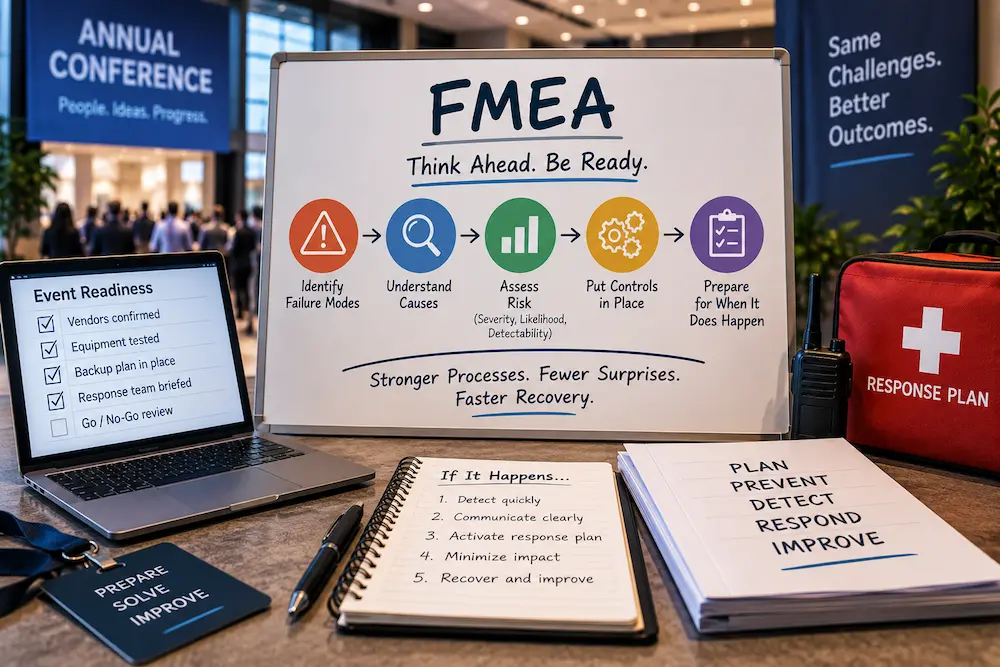
Six weeks before the company's biggest conference yet, the operations lead gets an email from her manager: "Let's make sure we fill out an FMEA on this one before we get burned again." Last year's event had a live-stream failure at the worst possible moment, right as the keynote speaker was being introduced in front of a client who'd flown in specifically to see it. Nobody wants a repeat.
She's never actually run one before, but she finds a spreadsheet from a previous project, a grid with columns for "failure mode," "effect," "cause," and a few risk numbers, and gets to work. Badge printer might jam. Effect: slow check-in line. Wi-Fi might drop. Effect: annoyed attendees. She fills in a dozen rows, mostly copied and lightly reworded from last year's version, sends it to her manager with a note that says "FMEA complete," and moves on to the fifty other things on her list.
The problem isn't that she failed to imagine the printer jamming. She did. The problem is that she stopped there. She never asked why it might jam, whether anything about this year's event made that cause more likely, how severe the resulting disruption would actually be, how easily the team would notice the problem before the line became unmanageable, or what they could do about it. "Printer might jam" was technically a failure mode, but it wasn't an analysis of the failure mode.
This year's event is bigger than any previous one: nearly triple the registrations and a new badge-printing vendor the team has never worked with before. The vendor had tested the printers, but only at the smaller volume they were used to handling. Nobody connected that fact to the dramatically higher demand expected during the first hour of check-in, and nobody put a mitigation or backup plan in place. The FMEA had identified the failure in name only. It had not helped the team understand, prioritize, prevent, detect, or recover from it.
Forty minutes into check-in on the first morning, the new badge printers start jamming under the actual load. The line stretches out the door. Someone posts a video of it. The keynote starts twelve minutes late while the team scrambles to hand-write badges. The irony is that the failure wasn't missed by the spreadsheet. "Badge printer might jam" was sitting right there. What was missing was everything that should have happened after identifying it: understanding the cause, assessing the actual risk, deciding what action was justified, and putting that action in place before the doors opened. That's the difference between filling out an FMEA and actually performing one.
What FMEA Actually Is
Failure Mode and Effects Analysis is a structured way of asking one question seriously, before something goes wrong, instead of after: what could fail here, and how bad would it actually be if it did? At its core, it starts with three simple questions. A failure mode is the specific way a step in a process could go wrong, not "check-in was bad" but "the badge printer jams under high volume." An effect is what actually happens as a result, to the attendee standing in that line, to the speaker waiting to go on, to the brand's reputation the moment someone starts filming. A cause is the reason that failure would actually occur in the first place, in this case, a printer model being used at a volume beyond what had been tested.
FMEA is my favorite Lean Six Sigma tool, and the reason is its diversity. There are plenty of tools that are excellent at answering a particular question, but FMEA can follow you into an enormous range of problems. It forces you to mentally walk through a process from start to finish, touching every step and asking what could go wrong at that point, what would happen if it did, why it might happen, and whether anyone would catch it in time. I like that it makes you slow down and actually walk the whole thing instead of allowing everyone to focus only on the part they already understand. That simple discipline exposes things that are remarkably easy to overlook when everyone is thinking about the process only in terms of how it is supposed to work.
That makes FMEA useful in more than one phase of a Lean Six Sigma project. When you're trying to understand why something has been going wrong, examining failure modes and their potential causes can identify issues worth investigating during Analyze rather than encouraging the team to jump straight to a solution. But the same thinking becomes even more valuable when selecting or implementing an improvement. Once you've decided what to change, you can ask what the new process, product, software release, machine, or workflow could fail to do, and put controls in place before those failures become the next problem.
The whole point of laying these out deliberately, before the event rather than during the post-mortem, is that prevention is generally cheaper and less damaging than cleaning up a failure after it happens. A twelve-minute-late keynote in front of a client who flew in to see it is a genuinely expensive failure, in relationship terms if nothing else. Catching "new vendor, triple the usual volume, never tested at this scale" in a planning meeting costs almost nothing by comparison. The entire discipline exists because most organizations are far better at explaining what went wrong after the fact than at seriously imagining what could go wrong beforehand, and FMEA is simply a structured way of forcing that imagination to happen on a schedule, before it's needed.
Why Not Every Risk Gets the Same Attention
A real event, or a real process of any kind, has dozens of ways it could go wrong, and treating all of them as equally urgent is its own kind of failure, because it spreads limited planning time so thin that nothing actually gets addressed properly. This is where FMEA asks a second layer of questions, beyond just naming what could go wrong: how severe would this actually be if it happened, how likely is it to happen at all, and how likely is the team to notice it building before it turns into a real problem.
A badge printer jam that's severe, genuinely likely given the volume and an unfamiliar vendor, and hard to detect until people are already standing in a long line, deserves real attention before the event. A slightly scuffed conference lanyard is a real failure mode too, technically, but it's mild enough in its effect that spending planning time on it would be its own form of waste. Weighing severity, likelihood, and how early a problem could realistically be caught is what turns a long list of hypothetical worries into an actual short list of things worth doing something about now.
The same logic applies when you're improving something rather than simply trying to protect an existing process. Imagine a software team redesigning its customer sign-up flow. The new design might remove three unnecessary screens, which sounds like an obvious improvement, but what happens if the change also removes an important validation step? What if an API fails halfway through registration? What if a user refreshes the page at exactly the wrong moment? What if an error message appears internally but tells the customer that everything succeeded? FMEA gives the team a structured way to think through those possibilities before the new design reaches thousands of users.
The Paperwork Trap
Here's the part that makes FMEA genuinely dangerous when it's done badly, and it's more dangerous than simply not doing one at all: a completed form creates the feeling that risk has been managed, whether or not any real thinking actually happened. "FMEA complete" sitting in an inbox reads exactly the same whether it came from an hour of serious, specific thinking about this event's actual new risks, or from copying last year's rows with the dates changed. Everyone downstream, the manager, the client, the rest of the team, now believes the risk has been assessed, and they plan accordingly. The paperwork didn't reduce any risk. It just quietly transferred everyone's guard down.
A genuine FMEA session requires the people who actually understand the specific process in front of them, not a generic template borrowed from somewhere else. For the conference, that means the person who's actually spoken to the new badge vendor, the person who knows how check-in behaves when attendance suddenly spikes, and the person who remembers exactly how last year's Wi-Fi failure happened and why. Their job in that room isn't to fill in boxes. It's to genuinely ask, out loud, "what's different this time, and what haven't we actually accounted for," and to keep asking until the obvious answers stop coming and the harder, more specific ones start.
This is also why an FMEA template should be treated as a thinking aid rather than a substitute for the thinking. The spreadsheet makes the analysis easier to structure, document, score, assign, and revisit, but the value is in what the team discovers while working through it. If you want a practical starting point, the Excel FMEA Template is available as a ready-to-use resource for building that analysis into an actual improvement project.
What the Real Version of That Meeting Would Have Found
Had that session actually happened for this event, the badge printer failure would have looked very different on the FMEA. The row wouldn't have stopped at "badge printer jams." The team would have asked what could cause it and quickly connected several facts: a new vendor, equipment that had only been tested at a lower volume, nearly three times the expected registrations, and a concentrated rush during the first hour. The effect would not simply be "slow check-in" either. The team would have considered the growing queue, frustrated attendees, reputational damage, and the possibility of delaying the keynote. The analysis would then have forced the next question: how will we know this is becoming a problem, and what are we going to do about it?
A real mitigation doesn't have to be dramatic. It could be as simple as stress-testing the new printers at the expected volume two weeks out, or having a backup manual check-in process ready and rehearsed rather than invented on the spot. Either one is a fraction of the cost of a viral video and a late keynote. None of that came out of a spreadsheet filled in alone at a desk. It comes out of the right people actually being made to think hard, together, about what's genuinely different this time.
And this is where the versatility of FMEA really starts to show. The same exercise could be used on the conference's registration process, the live-stream setup, the speaker onboarding process, the catering operation, or the process used to respond when something goes wrong. It could be used on the physical badge printer itself as a product, or on the process surrounding it. The object of the analysis changes, but the fundamental questions don't.
Where FMEA Becomes Especially Useful
The conference example makes the basic idea easy to see, but the same thinking becomes useful anywhere a process or product has multiple ways it can fail. A software team preparing a major release can walk through the process from code merge to deployment to customer use. A failure mode might be an environment variable missing in production. The effect could be a feature failing immediately after launch. The cause could be a configuration that exists in staging but was never replicated correctly in production. Another failure mode might be a database migration taking much longer than expected, with the effect being extended downtime and the cause being a data volume that was never represented in testing.
The same approach works for a digital customer journey. An online retailer could examine the process from product search through checkout and fulfillment. A failure mode could be a discount code appearing to be accepted while the discount is not actually applied to the order. The effect is an unexpected charge and potentially a support complaint. The cause might be a mismatch between front-end validation and the pricing service. Another failure mode could be a payment succeeding while the order confirmation fails, leaving the customer unsure whether they have been charged. Walking through the process step by step forces the team to think beyond the happy path and examine what happens when each part does not behave as intended.
It can be just as useful when a team is changing an existing process. Imagine a company replacing a manual approval workflow with an automated one. On paper, the improvement looks obvious: fewer handoffs, faster approvals, and less administrative work. An FMEA can expose what the new process could introduce in return. What happens if the automation sends an approval request to the wrong person? What if an integration fails after the request has been created but before the approval is recorded? What if an exception that a human used to notice is now processed automatically? The analysis can reveal weaknesses in the proposed improvement before the team discovers them in production.
The same principle applies to products. A product team can examine how a physical component, software feature, or combination of hardware and software could fail during use. It can look at what the customer experiences, what could cause the failure, how likely it is to occur, how easily it could be detected, and what controls could prevent it or make recovery easier. The object being analyzed changes, but the discipline of deliberately walking through how it could fail remains remarkably consistent.
This becomes particularly valuable when work crosses organizational boundaries. A process may begin with one team, depend on a third-party service, move through another team's system, require an approval in a different time zone, and eventually reach a customer who is the first person to discover that something went wrong. Each individual step can look perfectly reasonable when viewed in isolation. Walking through the complete process exposes the failure modes between those steps, which are often exactly where the most frustrating problems hide.
And FMEA doesn't have to end with prevention. If a failure cannot realistically be eliminated, the analysis can still help a team decide how to detect it earlier and recover faster. A deployment might need a reliable rollback procedure. A payment process might need a way to reconcile transactions when confirmation fails. A supplier process might need an alternative source when a delivery is missed. A customer support workflow might need a clear escalation path when an issue cannot be resolved at the first level. Sometimes the best improvement is not making failure impossible, but making the inevitable failure less damaging and much easier to recover from.
Where This Turns Into a Real Skill
Everything above is the concept, and it's worth understanding on its own. Actually facilitating a good FMEA session well, getting the right cross-functional voices in the room, keeping the group honest instead of settling for the first plausible-sounding answer, applying consistent criteria for severity, likelihood, and detectability so the results are comparable across different failure modes, and turning the findings into real action items that someone actually owns and follows through on, is a genuine, learnable skill. Treating the concept in this article as the whole skill would be exactly the same mistake as filling out last year's spreadsheet: something that looks like the real thing without actually being it.
One of the reasons FMEA remains my favorite Lean Six Sigma tool is that it doesn't force you to choose between prevention and problem solving. You can use it to understand why failures happen, to identify potential causes worth investigating during Analyze, to evaluate proposed improvements before implementing them, and to build controls that make the improved process more robust. It can help a team avoid a problem entirely, reduce the chance that it happens, make a failure easier to detect, or make recovery much faster when prevention isn't practical or possible.
That range is what makes FMEA so useful. It makes you slow down enough to understand the entire process or product, not just the part where the current problem happens. It gives a team a structured way to challenge assumptions, connect causes to effects, prioritize what actually deserves attention, and decide what should be prevented, detected, or recovered from. Few Lean Six Sigma tools are useful at that many points in the life of a process or product.
This same instinct, catching a small, specific weak point before it ever reaches a customer, shows up constantly outside of formal FMEA sessions too. Read about it here in the context of the everyday friction points most companies never bother to look for until a customer's already walked away over one.
Frequently Asked Questions
1. What does FMEA stand for, and what does it actually do?
Failure Mode and Effects Analysis. It's a structured way of identifying how a process or product could fail, what would happen as a result, why that failure could occur, and how well the failure could be detected, so the most important risks can be addressed before they become real problems.
2. What's the difference between a failure mode, an effect, and a cause?
A failure mode is the specific way something could go wrong, such as a printer jamming under high volume. The effect is what actually happens as a result, like a long check-in line and a delayed event. The cause is the reason the failure would occur, such as equipment being used beyond the volume at which it was tested.
3. Can FMEA be used to find root causes?
FMEA can help teams identify and examine potential causes of failure, which makes it useful during Analyze when investigating why problems occur. It should not automatically be treated as proof of a root cause by itself, though. When a suspected cause needs to be confirmed, other analysis and data should be used as appropriate.
4. Why doesn't every identified risk get equal attention in an FMEA?
Because treating every possible failure as equally urgent spreads planning effort too thin to fix anything properly. FMEA considers how severe a failure would be, how likely it is to happen, and how easily it could be detected before it causes real damage, helping the team focus on the risks that deserve action first.
5. Why is a poorly done FMEA sometimes worse than not doing one at all?
A completed form creates a false sense that risk has already been assessed, even when the analysis was shallow or copied from an unrelated project. That false confidence can lead a team to skip other precautions they might otherwise have taken, since everyone downstream assumes the risk has genuinely been managed.
6. Who should actually be in the room for an FMEA?
The people who genuinely understand the specific process or product being examined, not a generic template borrowed from an unrelated project. That usually means a small cross-functional group who can speak to how the work actually happens, what has changed, where dependencies exist, and what failures they have seen or could realistically imagine.
7. What kinds of processes and products can FMEA be used for?
FMEA can be used for physical products, services, software, digital customer journeys, administrative workflows, healthcare processes, supply chains, manufacturing processes, and almost any other process or product where failures have meaningful consequences. The underlying questions, what could fail, what would happen, why would it happen, and how would we detect or recover from it, apply across a remarkably wide range of work.
8. Can FMEA be used when implementing an improvement?
Absolutely. FMEA is useful before implementing an improvement because it lets a team examine how the new process, product, system, or workflow could fail. That can reveal weaknesses in the proposed solution, identify controls that should be added, and make recovery plans faster and more reliable if something does go wrong after implementation.
9. Can FMEA be used for software and digital processes?
Yes. A software team can use FMEA to examine everything from deployment and database migrations to customer registration, payment processing, integrations, analytics, and error handling. Digital processes often involve many systems, vendors, teams, and handoffs, which makes deliberately walking through the entire process especially valuable.
10. Where can I get an FMEA template?
You can start with the Excel FMEA Template, which provides a practical structure for documenting failure modes, effects, causes, risk evaluation, and improvement actions.