
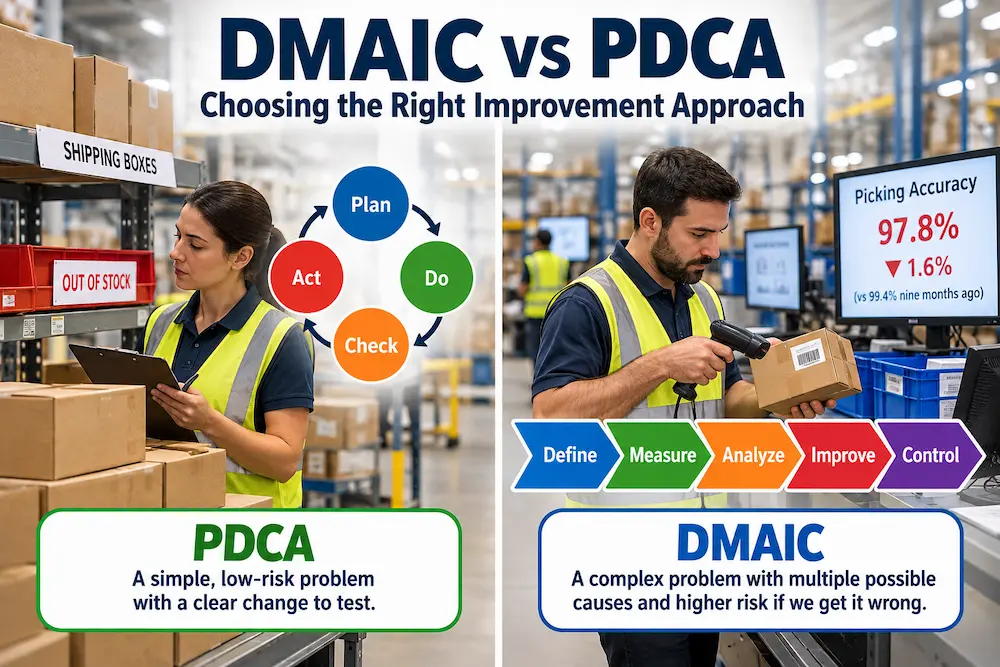
The operations manager at a growing fulfillment center has two problems on her list, and at first glance they look like the kind of problems that should be handled the same way. The first: one packing station keeps running out of a particular size of shipping box, creating a few minutes of disruption several times a week. The second: order-picking accuracy has fallen from 99.4% to 97.8% over the past nine months, creating rework, customer complaints, and a growing number of returns. She could put both problems into the same formal improvement process, collect data for weeks, and build a detailed project plan. But for one of these problems, that would be unnecessary. For the other, it could be exactly what is needed.
This is the practical question behind two of the most commonly confused improvement frameworks: DMAIC and PDCA. Both are designed to improve a process. Neither is simply the "advanced" version of the other. They provide different levels of structure for different situations, and knowing which one a problem actually needs is part of good process improvement.
The Box Problem, and Why It Doesn't Need Much Ceremony
Start with the shipping boxes, because this is the kind of problem where a short improvement cycle makes sense. The issue is visible, the likely cause is reasonably clear, the change is inexpensive, and a wrong guess is easy to reverse. That is exactly the kind of situation where PDCA: Plan, Do, Check, Act can be useful.
The manager's initial hypothesis is that the reorder point for that particular box size is simply too low for the current shipping volume. She plans a small change: increase the reorder threshold and have the packing lead check the stock level at the end of each shift for two weeks. She does it, watches what happens, and finds that the stockouts stop. She then makes the new reorder point part of the normal replenishment process. If the problem had continued, she could have changed the threshold again or tested another reasonable explanation without having invested weeks in a formal project.
PDCA fits a problem like this because the situation is already reasonably well understood, the potential change is cheap and reversible, and the consequences of being wrong are small. Nobody needs a major analytical project to test whether a replenishment threshold is too low. They need to make a sensible change, observe the result, and learn from what happens.
The Picking Problem, and Why the Same Approach Would Fail It
The decline in order-picking accuracy is a very different problem. There isn't one obvious explanation to test. The change could be related to warehouse layout, similar-looking products, new employees, shift differences, changes in order volume, scanning behavior, inventory accuracy, system changes, or several of these factors interacting. The cost of getting the answer wrong is also much higher because every incorrect order creates additional work and can reach the customer.
This is where a quick guess-and-check approach can become misleading. Imagine the manager changes the warehouse layout, sees the accuracy rate improve the following month, and declares the problem solved. Without understanding the data behind the change, she cannot know whether the layout actually caused the improvement or whether the result was simply normal variation that happened to move in the right direction that month. A lucky improvement gets credited to the change, the actual driver remains unidentified, and the problem can return later.
This is the kind of problem DMAIC: Define, Measure, Analyze, Improve, Control is designed to address. It provides a more structured path because the situation is not yet well understood and the cost of guessing wrong is significant.
Define means getting precise about what is actually being improved and why it matters. "Improve picking accuracy" is a starting point, not a useful project definition. The team needs a clear problem statement, a defined scope, a baseline, and a measurable target.
Measure means understanding what is actually happening before changing the process. Picking errors can be examined by shift, product type, warehouse zone, employee experience, order type, time of day, or other factors that may reveal a meaningful pattern. The goal isn't to collect data simply because DMAIC says to collect data. The goal is to understand the process well enough to make the next decision intelligently.
Analyze means using that evidence to distinguish plausible explanations from actual contributors. A team might discover, for example, that errors are concentrated in one warehouse zone where several visually similar products are stored next to each other. That is a much more actionable finding than assuming employees simply need to "pay more attention."
Improve means designing and testing a change based on what the analysis actually revealed. The team might change product locations, introduce a scanning confirmation, improve visual identification, or test another targeted intervention. The improvement is connected to an identified cause rather than being the first idea proposed in a meeting.
Control means making sure the improvement survives after the project receives less attention. That could involve a process measure, a control chart, an updated standard, an automated check, or another appropriate control. The point is not to create paperwork. The point is to make sure a temporary improvement doesn't quietly disappear three months later.
The Actual Decision, Made Explicit
Stripped down to the practical choice a manager actually has to make, the decision comes down to four questions. How many plausible causes are realistically in play: one obvious suspect or several competing possibilities? How costly is it if a quick guess turns out to be wrong: cheap and easily reversed, or expensive and difficult to undo? How well is the current situation already understood: is the "why" reasonably clear, or is it still genuinely uncertain? And how much evidence is needed to know that the change actually worked: a quick check after implementation, or data and ongoing monitoring that demonstrate the improvement is real and sustained?
When the answers are "one clear suspect, cheap to test, already understood, and easy to verify," that's PDCA territory: fast, focused, and appropriately lightweight. When the answers are "several plausible causes, expensive to get wrong, poorly understood, and requiring evidence that the improvement is real," that's DMAIC territory. The objective isn't to make every problem into a formal Six Sigma project. It's to give the problem enough structure to solve it properly without creating unnecessary work.
The Trap in Both Directions
Using PDCA on a DMAIC-sized problem produces a familiar pattern: a series of quick fixes, each one tried with good intentions, none of them supported by enough evidence to establish what is actually driving the problem. The team keeps changing things, occasionally sees the number improve, and then watches the problem return because the underlying cause was never properly understood.
Using full DMAIC ceremony on a PDCA-sized problem creates the opposite kind of waste. A team can spend weeks defining, measuring, and analyzing a replenishment threshold that could have been changed and checked in an afternoon. The issue isn't that the DMAIC tools are wrong. The issue is that the problem didn't require that level of effort in the first place.
Good improvement work isn't about applying the most sophisticated methodology available. It's about matching the method to the problem.
Choosing the Right Level of Rigor
Knowing which framework fits a given problem is the useful, immediately applicable skill this article is actually about. Running a full DMAIC project well is a different skill. Defining a scope tightly enough to be useful, choosing the right data to collect, selecting appropriate analytical methods, designing a valid improvement test, and building controls that continue working after the project ends all require real tools and real technique.
The same applies to PDCA. A short cycle doesn't mean an unstructured one. A good Plan still needs a sensible hypothesis, the Do should be a deliberate test rather than random experimentation, the Check should look at what actually happened, and the Act should turn a successful change into the new way of working or lead to the next cycle.
The goal here is choosing the right approach. Learning how to execute these methods properly is a separate skill, and one that takes practice with real problems and real improvement tools. Our Lean Six Sigma certification courses take you through that practical application, from selecting the right approach to running an improvement project through to measurable results.
The Lean 6 Sigma Factory DMAIC Cycle Roadmap was reworked with the practitioner in mind: helping teams deliver results in a reasonable timeframe while using the tools that make sense for the problem at hand. It also recognizes that not every improvement opportunity needs to follow the full DMAIC path, with a Quick Win PDCA stream built directly into the roadmap.
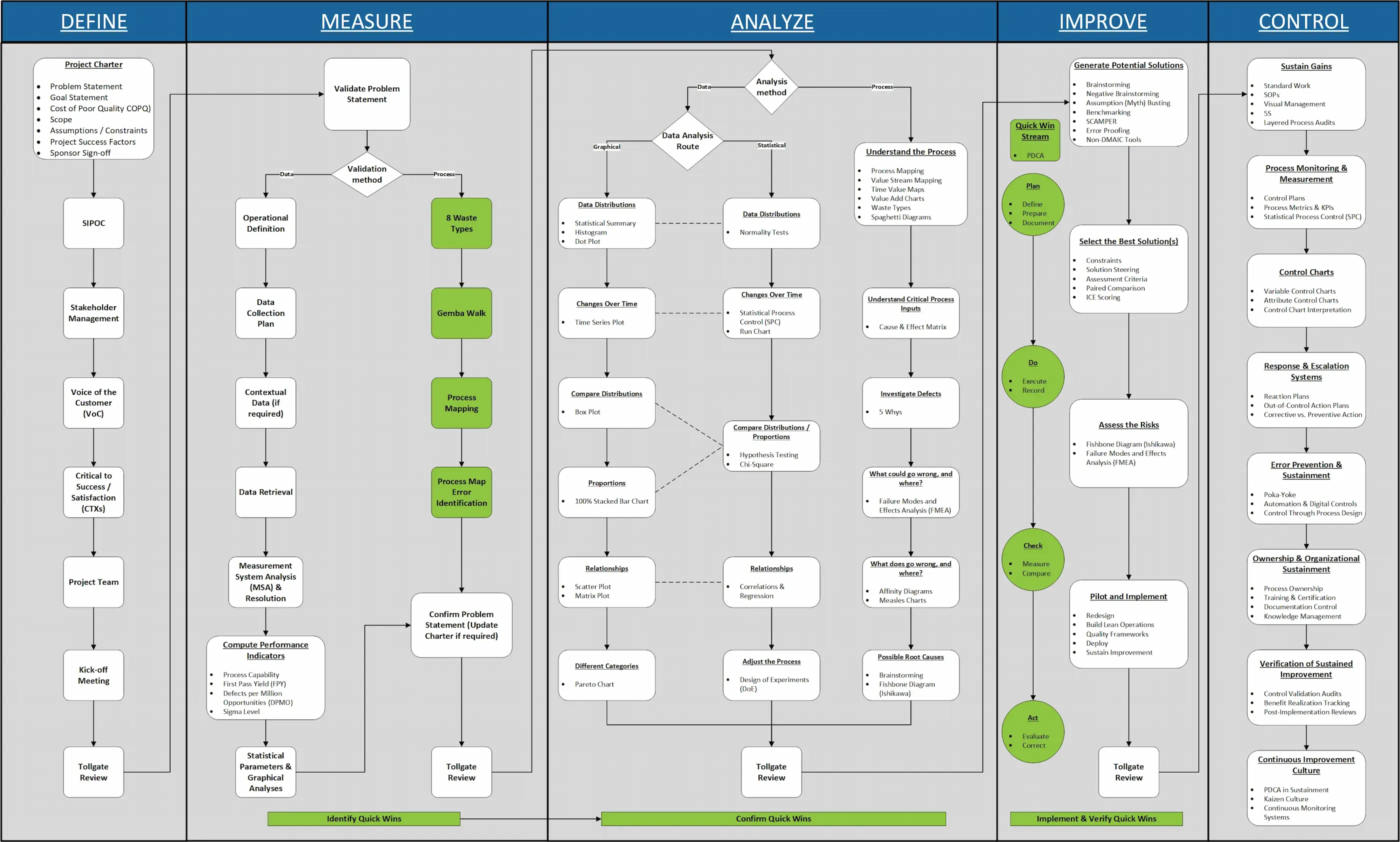
The Lean 6 Sigma Factory DMAIC Cycle Roadmap shows the tools available across each DMAIC phase, with a Quick Win PDCA stream for improvement opportunities that do not require the full DMAIC path.
For problems that genuinely suit a fast improvement cycle, the Lean 6 Sigma Factory PDCA Cycle Project Template provides a practical workbook for planning, testing, checking, and acting on a focused improvement without turning a simple problem into a major project.
Back at the Fulfillment Center
The operations manager ends up handling both problems, but not in the same way. The box shortage is resolved through a short PDCA cycle: the reorder point is changed, stockouts stop, and the new threshold becomes part of the normal replenishment process. There is no reason to turn that problem into a six-week improvement project.
The picking accuracy problem takes a different path. The team defines the problem, establishes the baseline, examines the errors by product, location, shift, and other relevant factors, and finds that a disproportionate share of the errors comes from a group of visually similar products stored together in one zone. The team tests a targeted change, measures the result against the baseline, and then puts a simple ongoing check in place to make sure the improvement holds.
One problem needed a quick, disciplined experiment. The other needed evidence before anyone could reasonably claim to know what was wrong. Neither approach was inherently better. The useful skill was recognizing the difference before wasting time, money, or attention on the wrong level of effort.
Frequently Asked Questions
1. What's the basic difference between DMAIC and PDCA?
PDCA, Plan-Do-Check-Act, is a fast improvement cycle suited to problems that are reasonably understood and where changes can be tested quickly and cheaply. DMAIC, Define-Measure-Analyze-Improve-Control, provides a more structured, data-driven approach when the cause is genuinely uncertain or the cost of getting the answer wrong is significant.
2. Is DMAIC just a more advanced or "better" version of PDCA?
No. They are designed for different situations rather than different levels of skill. Applying full DMAIC rigor to a simple problem can create unnecessary work, while using a quick PDCA-style approach on a complex problem can lead to repeated guesses without ever identifying the real driver.
3. How do you decide which framework fits a given problem?
Consider how many plausible causes are in play, how costly a wrong guess would be, how well the current situation is understood, and how much evidence is needed to establish that an improvement worked and will continue to work. Simple, well-understood, low-risk problems often suit PDCA. Complex, poorly understood, higher-risk problems may require DMAIC.
4. What's the risk of using PDCA on a complex problem?
A quick change can appear to work without actually addressing the underlying cause. The improvement may simply coincide with normal variation or another change in the process, leaving the original problem unresolved and encouraging the team to keep trying additional fixes.
5. What's the risk of using DMAIC on a simple problem?
Applying extensive measurement and analysis to a problem that can be safely tested with a small change can consume time and attention without adding enough value to justify the effort. The methodology isn't the problem. The mismatch between the methodology and the problem is.
6. Can both frameworks be used at the same time on different problems?
Absolutely. An organization can use PDCA to resolve a straightforward operational issue while running a DMAIC project on a more complex problem at the same time. The important point is that each problem gets the level of structure and rigor it actually needs.