
In the modern professional landscape, we are drowning in data but starving for improvement. Organizations across the globe are stuffed with Project Managers moving Gantt chart bars like Tetris blocks and Data Analysts building models that predict the future. Yet, projects still fail, deadlines slip, and processes remain riddled with invisible friction.
The reality is that most businesses operate in a state of functional silos. The tech team doesn't speak "finance," the marketing team doesn't speak "data," and the travel industry is struggling to keep up with its own logistics. This is where Lean Six Sigma (LSS) enters the room. It is the "universal translator" of the modern enterprise.
But as more professionals look to get certified, a territorial debate has sparked: Is LSS more suitable for the technical analyst or the people-leading manager? The answer is that LSS is a bridge. Depending on where you start, you are simply standing on a different end of that bridge. Let’s explore the "head starts," the technical DNA, and the transformative power of LSS across the entire professional spectrum.
1. The Project Manager: From Taskmaster to Process Architect
For a Project Manager (PM), Lean Six Sigma is often the difference between being a coordinator and being a strategist. Most PMs spend their days chasing people for updates; LSS turns them into the people who redesign the system so those updates happen automatically.
The Head Start: The Human Element
LSS is famously described as being 50% technical and 50% psychological. You can have a statistically perfect solution, but if the frontline staff refuses to use the new software, the project is a failure. PMs are already experts in Stakeholder Diplomacy. They know how to navigate the frozen middle of management and secure the political air cover needed for a project to survive.
The DMAIC Edge: Define and Improve
The Define Phase: Most LSS projects fail because the problem wasn't defined correctly. PMs are trained to ask, "What is the goal?" and "What is out of scope?" They prevent Scope Creep from turning a 3-month project into a 2-year nightmare.
The Improve Phase: This is where the PM’s soft skills shine. They understand Change Management. They don't just deploy a solution; they transition a team into a new way of working.
The Transformation
LSS gives the PM a Scientific Backbone. Instead of saying "I think we improved the workflow," they can now say, "We reduced process variation by 65%, resulting in a €300,000 quarterly saving." It moves the PM from a soft organizational role to a hard financial asset.
2. The Data Analyst & BI Professional: The Truth-Seekers
If the PM is the architect, the Data Analyst is the structural engineer. Analysts often feel like they are shouting into a void, providing reports that no one reads and insights that no one acts upon. LSS is the transmission that connects their engine of data to the wheels of the business.
The Head Start: Technical Rigor
Measure & Analyze
This is where the Analyst dominates. While others struggle with basic Excel formulas, the Analyst is performing Regression Analysis or Hypothesis Testing (T-Tests, ANOVA).
Data Integrity
A fundamental tenet of LSS is "garbage in, garbage out." Analysts are the guardians of the data. They understand Measurement System Analysis (MSA) and won't start a project until they’ve proven the data isn't lying.
Leveraging Advanced Tools
Modern Analysts don't just use Minitab; they leverage Python, SQL, and R.
Automation
An analyst can use Python to build automated Control dashboards that alert the team the second a process starts to drift out of statistical control.
Validation
They have the technical skills to perform complex multi-variate analysis, identifying the vital few variables that actually drive defects, rather than chasing the trivial many.
The Transformation
LSS teaches the analyst to lead with Impact. It forces them to move past "finding trends" and into "implementing solutions." It teaches them how to package a P-value into a business case that a CEO can understand.
3. The Tech Heavyweights: Product, AI, and Automation
In a technology-heavy world, waste isn't a broken physical part; it’s a feature no one uses, a bug that keeps reappearing, or a server that is running at 10% capacity.
Product Owners (POs)
POs are the bridge between the customer and the code. They are already experts at prioritizing backlogs, but LSS gives them a framework for Efficiency.
Value Stream Mapping (VSM)
A PO can use VSM to visualize the time from the moment a user requests a feature to the moment it’s deployed (Lead Time). They often find that the actual "coding" only takes 10% of the time, while 90% is spent waiting for approvals or testing.
Reducing WIP
LSS teaches POs the danger of Work in Progress. By limiting WIP, they actually increase the velocity of the dev team.
AI and Automation Practitioners
This is the new frontier. Many think AI replaces LSS, but the opposite is true: AI requires LSS.
The Golden Rule
You cannot automate a broken process without simply making the mistakes happen faster.
Standard Work
Before an AI practitioner builds a bot, they must use LSS to create "Standard Work." If the process isn't stable and repeatable, the AI will fail.
The SIPOC and Process Model Advantage
AI practitioners use SIPOC (Supplier, Input, Process, Output, Customer) diagrams and Process Models to define exactly what data the AI needs and what the success output looks like.
4. The Central Nervous System: HR, Finance, and Payments
These departments are the hidden engines of the company. When they are inefficient, the entire organization feels the friction.
Human Resources (HR)
People often forget that HR is one of the most process-heavy departments.
The Time to Hire Problem
If it takes 60 days to hire a software engineer, the company is losing revenue every day that seat is empty. This is a Waiting waste.
LSS in HR
By mapping the hiring funnel, HR can identify where candidates are dropping out. Is it a redundant interview? A slow background check? LSS provides the data to trim the fat from the recruitment process.
Finance and Payments
In Finance, a defect is a decimal point in the wrong place. In Payments, a defect is a delayed transaction.
Zero Defects
Finance professionals are naturally aligned with the Six Sigma goal of near-perfection. They use LSS to eliminate Rework in account reconciliations.
Payment Optimization
Payment professionals use LSS to analyze False Declines. If a legitimate customer’s card is declined, that is a defect. LSS helps find the root cause in the fraud detection algorithm to ensure flow for the customer.
5. The Guardians of Standards: Quality Assurance (QA)
QA personnel are the natural home for LSS. Their entire career is built on identifying defects, but LSS shifts their focus from Detection to Prevention.
Mapping the Flow
QA pros are often the first to notice when a process is over-processing.
Over-testing
In software, testing everything manually every time is a massive waste. LSS helps QA identify the high-risk areas that require focus, while automating the stable areas.
Waste Identification
They are trained to see Over-production. E.g., creating 50-page test plans that no one reads. LSS helps them streamline documentation to focus on what actually ensures quality.
Poka-Yoke (Error Proofing)
The ultimate QA tool is the Poka-Yoke. Instead of checking for an error, you design the process so the error cannot happen. QA pros use LSS to move upstream in the development cycle, ensuring quality is baked in from the start.
6. The Travel & Tourism Industry: Managing Massive Flow
If you want to see a process flow under extreme strain, look at a modern airport or a global hotel chain. The travel industry is a textbook case for Lean.
The Bottleneck Challenge
Travel professionals deal with perishable inventory. A seat on a flight from London to New York has zero value once the cabin door closes.
Airport Flow
LSS is used to analyze the passenger journey. By using Bottleneck Analysis, airport managers can determine exactly how many security lanes need to be open to keep the "Curb-to-Gate" time under 30 minutes.
Website UX
In travel e-commerce, every extra click in the booking process is "Extra Processing" waste. LSS helps digital teams use data to find where customers are looping or getting stuck, streamlining the path to purchase.
Reducing Variation
In travel, consistency is the product. If one hotel room is clean in 20 minutes and another takes 45, the system breaks. LSS helps managers standardize turnover Times, ensuring the guest experience is the same in Tokyo as it is in Paris.
7. The Healthcare Professional: Precision Under Pressure
In a hospital, a defect isn't a broken widget; it’s a patient safety risk. Healthcare is perhaps the most fertile ground for LSS because the wastes are so visible and the consequences are so high.
The Strategic Edge: Gemba Knowledge
Nurses and clinical administrators live at the Gemba (the place where the work happens). They don't need a map to find the bottleneck; they are standing in it.
Reducing "Door-to-Balloon" Time
In cardiac care, every second counts. Healthcare pros use LSS to map the "Value Stream" of a patient arriving at the ER. They identify "Non-Value-Added" steps (like waiting for a specific signature or searching for a gurney) and eliminate them.
Medication Error Reduction
By using Poka-Yoke (Error Proofing) and Standard Work, clinical teams can ensure that the right patient receives the right dose at the right time, every single time.
The Benefit: From Burnout to Flow
Healthcare workers are often exhausted by workarounds, fixing the same broken process ten times a shift. LSS empowers them to fix the process permanently, allowing them to focus on patient care rather than administrative friction.
8. The Commercial Powerhouses: Marketing and Sales
Marketing and Sales are often seen as creative or intuitive fields. LSS proves that they are actually high-volume processes that thrive on Predictability.
Marketing Funnel Physics
Marketing is essentially a Value Stream for leads.
Design of Experiments (DOE)
This is the Six Sigma version of A/B testing. Instead of guessing which ad works, Marketing pros use DOE to statistically prove which combination of variables (headline, image, call-to-action) drives the highest conversion at the lowest cost.
Content Waste
Lean Marketing looks at the content factory. If a blog post takes 4 weeks to move from draft to live because of 5 layers of approval, that is "Waiting" waste.
Sales Operations
Sales Ops uses LSS to analyze the Sales Cycle Time.
Root Cause Analysis
If a sales team is missing their quota, LSS prevents the blame game. It allows the manager to look at the data: Is the problem the Lead Quality (Input) or the Closing Process (Process)?
Win Rate Optimization
By finding the Standard Deviation in how the top 10% of salespeople work, Sales Ops can create Standard Operating Procedures, or Standard Work that helps the other 90% improve.
The Comparative Advantage
The fact of the matter is, no matter what your profession is, LSS is a fit for you, and you most certainly will have an a certain advantage in one or more skills required to run a successful Lan Six Sigma project.
A Project Manager understands stakeholder and change management, yet Lean Six Sigma will compliment this with flow, statistical evidence and financial proof.
A Data Analyst / BI will thrive in Math & Data Validation while Lean Six Sigma will add strategic Influence and implementation skills to their repertoire.
A Product / AI specialist understands system logic while Lean Six Sigma will add process stability and Work-In-Progress (WIP) Control.
Quality Assurance personnel are able to track in fine detail better than most. Lean Six Sigma will teach them how to add prevention and Poka-Yoke into their daily work.
An HR specialist has organizational empathy but might lack data-driven talent pipelines, which LSS can support them with.
Finance / Payments truly understand audits and standards while they will learn velocity and friction reduction.
Travel and Tourism professionals have already studied and understand flow but can benefit heavily with Lean Six Sigma to learn about bottleneck and variation control.
Healthcare professionals live and breathe patient flow empathy but they can add error-proofing and safety systems.
Sales and Marketing teams will have a leg up with their understanding of the Voice of the Customer, whereas they can improve in predictability and funnel physics.
At the end of the day, no matter your profession or background, you will bring a certain skillset that can be utilized in the Lean Six Sigma methodology, and you will surely take home new skills to improve your daily life.
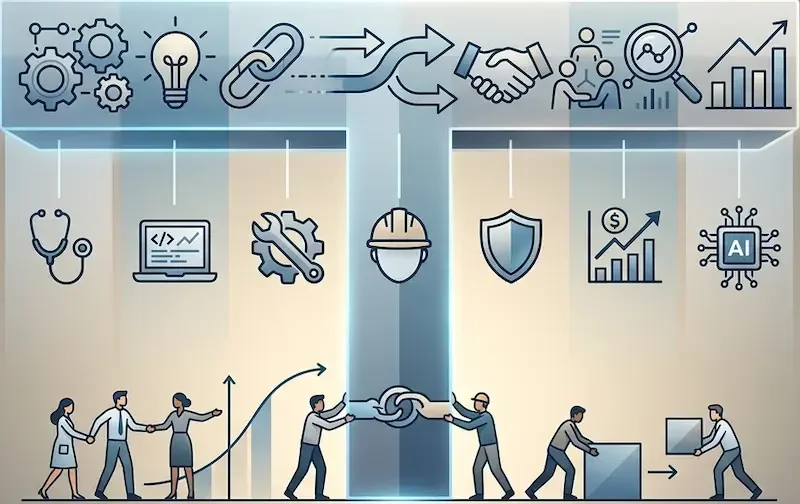
The Verdict: The Rise of the "T-Shaped" Professional
So, who is Lean Six Sigma really for? It is for the person who refuses to stay in their silo. It is for the professional who wants to become "T-Shaped."
The vertical bar of the "T" is your Deep Expertise. It’s your Python coding, your nursing degree, your PM certification, or your Sales experience. This is what gets you the job.
The horizontal bar of the "T" is Lean Six Sigma. This is the ability to work across departments, to speak a common language of data, and to drive improvements that actually stick. This is what gets you the promotion.
Whether you start your day with a calculator, a stethoscope, a sales script, or an AI prompt, LSS doesn't replace your skills but rather weaponizes them. In a technology-heavy, hyper-competitive world, the question isn't whether you are suitable for LSS; it’s whether you can afford to remain a one-dimensional professional in a multi-dimensional world.
Lean Six Sigma is the bridge between doing the work and making the work better. And in the end, the person who can make the work better is always the most valuable person in the room.