
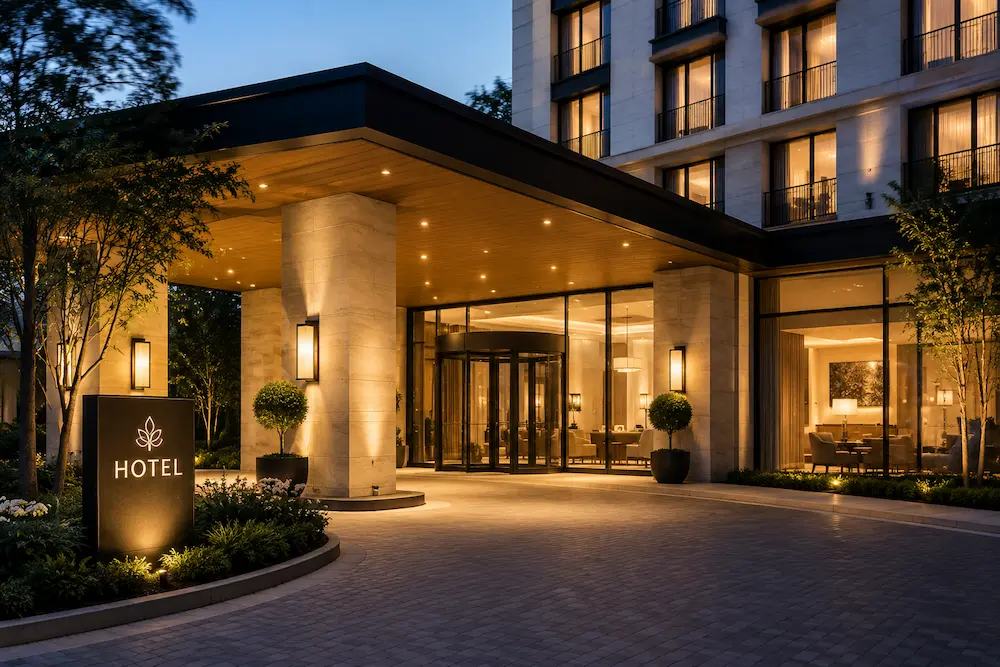
You check in at 3:04 p.m., four minutes after the posted check-in time, and your room is ready. Not "ready" in the sense that the door will unlock, but actually ready: made bed, stocked minibar, fresh towels folded the same way they were the last time you stayed at this brand, three cities away. You mention offhand that the air conditioning sounds a little loud, and by the time you've unpacked your bag, an engineer has already been in, adjusted it, and left a card apologizing for the inconvenience. Room service arrives at the time they quoted, not the time they hoped for. Checkout, two mornings later, takes forty seconds, because the folio already matches what you actually spent, down to the mini-bar water you had at 11 p.m. on night one.
None of that happened by accident, and none of it happened because the staff you interacted with were simply nice people having a good day, although they probably were. It happened because a hotel is one of the most rigorously engineered guest experiences in modern business, built from dozens of small, deliberately designed systems that you're not supposed to notice at all. The fact that you didn't notice any of them is the actual achievement.
The Room You Never See Being Made
Start with the room itself, because it's the part every guest judges most and understands least. A housekeeping attendant at a full-service hotel is typically expected to clean somewhere between 12 and 16 rooms in an eight-hour shift, a benchmark that hospitality operations research has refined for decades, balancing speed against a quality bar that can't slip no matter how far behind the day is running. That pace only works because almost nothing about it is left to individual judgment. There's a defined sequence for the room (top to bottom, clean to dirty, so a vacuumed floor doesn't get re-dirtied by a dusted shelf), a defined chemical for every surface, and a defined checklist, typically covering 18 to 22 separate inspection points, from the coffee maker on the counter to the fold on the toilet paper.
The staffing structure behind that pace is its own quiet piece of engineering. Larger properties don't ask every housekeeper to do everything. A "stripper" pulls used linens and trash from checkout rooms ahead of the cleaning team, so the attendant assigned to that room never opens the door to a mess; a "runner" restocks carts with linens, amenities, and supplies mid-shift, so nobody's making a return trip to the supply closet on the other end of the floor. Where the supply closets themselves sit is a deliberate decision too: placed near the rooms attendants are actually working that day, not centralized in one convenient spot for management to walk past. Every extra minute an attendant spends walking to fetch a towel is a minute not spent on the actual room, and multiplied across dozens of rooms and hundreds of shifts a year, that minute is real money and real guest wait time.
Then there's the part guests never see at all: a supervisor inspects a sample of finished rooms against that same checklist before the room ever shows as available in the property system. A room that fails goes back for a re-clean, and well-run housekeeping departments track that re-clean rate closely, keeping it under 5%, because a high failure rate isn't just wasted labor, it's the leading indicator that either training is slipping or the pace being demanded is no longer realistic. The guest checking in at 3:04 never sees any of this. They just experience a clean room, on time, and assume that's simply how hotels work.
Why Rooms Are Ready at All, Given Who's Cleaning Them
Here's what makes that consistency more impressive than it looks: the hospitality industry runs on brutal staff turnover. Separation rates in U.S. hospitality run 70 to 80% annually according to Bureau of Labor Statistics data, meaning a housekeeping department of thirty people is, in a typical year, functionally a different department by the time the calendar turns over. A brand-new housekeeper isn't cleaning at full pace or full quality on day one. That gap has to be absorbed somewhere, by training time, by supervisor attention, by other staff quietly picking up slack, and it never fully shows up on a productivity report the way it should.
This is exactly why the checklist, the defined sequence, and the documented standard exist in the first place. A hotel that depended on tenure and instinct to maintain quality would fall apart under that kind of churn within a single season. A hotel that documents the standard down to the fold of a towel can put a new hire through two or three weeks of structured training and get them close to full productivity almost immediately, because the job was never designed to depend on any one person's five years of accumulated intuition. The standard is the institution's memory. People come and go constantly; the standard doesn't.
The Discipline Actually Has a Name
None of this happened because hotel operators are simply more disciplined people than everyone else. Hospitality made a deliberate, funded bet on formal process improvement earlier than most service industries did. Starwood Hotels became the first major hospitality company to adopt Six Sigma company-wide, in 2001, training staff across properties in the same structured problem-solving methodology that had spent the prior two decades refining manufacturing lines. According to accounts documented by industry researchers tracking the rollout, the program was credited with well over $100 million in profit improvement in the years that followed, and other major brands, including Marriott, Hilton, and the Ritz-Carlton, built their own versions of the same discipline into how they train staff and run properties.
Starwood Hotels is, as it happens, exactly where my operational excellence journey started. Not on a factory floor, but inside a hotel, learning why a housekeeping cart was parked exactly where it was parked, and why a checklist existed for a room nobody was ever going to inspect twice. Hospitality is, in many respects, the industry that proved this way of thinking was never actually about manufacturing at all. It was always about designing a process precise enough that a quality guest experience didn't depend on which person happened to be working that day, and hotels bet on that idea, formally and with real budget, before most other service industries thought to.
The Math Behind "Almost Always"
It's worth being precise about how good this actually is, because the number is more striking than "pretty good service" suggests. The J.D. Power 2025 North America Hotel Guest Satisfaction Index, based on 39,219 guest responses across 102 brands, found that only 12% of hotel stays involve any kind of problem at all, whether that's a housekeeping issue, excessive noise, or a check-in dispute. Turn that around: roughly seven out of eight stays go by with the guest never having a single thing worth complaining about, across an experience that involves dozens of separate handoffs between departments, shifts, and systems.
The same study found something worth sitting with if anything does go wrong: when a guest does experience a problem, satisfaction doesn't dip a little, it collapses, falling 217 points on J.D. Power's 1,000-point scale, from 677 down to 460. That's not a rounding error. It's the same compounding fragility that shows up in any long chain of dependent steps: each individual link can be running well, but the one link that fails is the one the guest actually remembers, and it erases the credit earned by every other link that quietly worked.
The Recovery Is Also Engineered
Which is exactly why the loud air conditioner in the opening story got fixed before you'd even finished unpacking, instead of sitting in a maintenance queue for two days. The most cited example of this in the industry is the Ritz-Carlton's long-standing policy, put in place by co-founder Horst Schulze, giving any employee, from housekeeping to the front desk, authority to spend up to $2,000 per guest, per incident, to resolve a problem on the spot, without asking a manager first. Almost nobody ever spends close to that. The number was never really the point. The point is that the person standing in front of the problem, the one who can actually see and hear how much it's bothering the guest, gets to solve it immediately, instead of routing it through someone three levels away who wasn't in the room and doesn't feel the urgency.
That kind of recovery isn't improvisation, even though it feels spontaneous to the guest receiving it. It's a designed control, built specifically for the 12% of stays where something inevitably slips through, because no amount of process discipline gets a system with this many moving parts to zero defects forever. The engineering that keeps a hotel "almost always flawless" isn't just prevention. It's also a deliberate, pre-authorized plan for the moments prevention doesn't fully work.
Everything Else Happening While You're Not Looking
The room and the recovery are the most visible pieces, but they're sitting on top of a much larger structure most guests never think about at all. Revenue management teams forecast occupancy weeks and months out, typically on 30, 60, and 90-day horizons, not just to set the room rate, but to give workforce managers the numbers they need to schedule the right number of housekeepers, front desk agents, and engineers for the volume actually expected; overstaff and the payroll eats the margin, understaff and check-in lines grow and rooms aren't ready on time. Night audit runs while the building sleeps, reconciling every folio, every posted charge, and every rate discrepancy so that the bill you glance at during a forty-second checkout is actually correct, instead of something a front desk agent has to untangle in front of you the next morning. Room blocking assigns specific rooms days in advance based on loyalty tier, accessibility needs, and requests like adjoining doors or high floors, so that a returning guest gets the room type they expect without anyone scrambling at 2:58 p.m.
The kitchen runs on the same discipline, whether it's plating three hundred identical banquet dinners within minutes of each other or getting a room service order to the right floor at the temperature it left the pass. Mise en place, everything prepped, portioned, and in its place before service starts, is standard work by another name, and it's the reason a hotel restaurant can turn out a consistent dish at 7 p.m. on a Tuesday and again at 7 p.m. on a Saturday during a full banquet weekend, with different cooks on the line each time. Engineering teams run preventive maintenance schedules specifically so that air conditioning units get serviced before they start rattling in an occupied room, not after a guest complains. Evacuation and emergency procedures get drilled on a set schedule for an event that, with any luck, never happens at all, because the cost of being unprepared for the rare catastrophic case is asymmetric with the cost of the drill.
Cutting Cost Without Cutting the Thing That Works
Hotels also live under real financial pressure, thinner margins than most guests assume, and they run cost reduction efforts constantly. The discipline in a well-run property is in where those cuts land. Renegotiating a linen supplier, adjusting par levels so fewer clean towels sit unused in a closet at any given time, or scheduling HVAC to reduce energy draw in unoccupied rooms all protect margin without touching a single guest-facing minute or a single headcount. The failure mode, and it's a common one industry-wide, is cutting the housekeeping staffing ratio itself to hit a budget target, which quietly pushes rooms-per-shift past what quality can support, and the re-clean rate and the guest complaint rate rise together a few months later, right when the report that would explain why has already moved on to the next quarter. The hotels that stay "almost always flawless" for years, not just one good season, are the ones disciplined enough to find the waste instead of the muscle.
The Guest Is Only Half the Story
Everything above only works because of a second, less visible decision hotels make: they extend the same operational seriousness inward, to the people actually doing the work, that they extend outward to the guest. A housekeeper given a real checklist, a workable pace, supplies staged where they're actually needed, and the authority to flag a maintenance issue without waiting for permission is a housekeeper capable of hitting that 12-to-16-room target without cutting a corner nobody will notice until a guest does. A front desk agent trusted with a real budget to fix a guest's problem on the spot, rather than a scripted apology and an escalation form, is an agent who can actually close the loop in the moment instead of promising a callback that may or may not happen.
That's the part of hotel operations that generalizes furthest beyond hospitality, and it's worth stating plainly: the guest experience was never really the starting point. It's the visible output of how seriously the business treats the employee standing between the guest and the outcome. A retailer whose checkout keeps failing on the same edge case, or a company whose new hires quietly disengage over an unanswered complaint about a broken tool, is missing the same ingredient a badly run hotel is missing: someone treating the internal customer, the employee actually doing the work, with the same design discipline usually reserved for the person paying the bill. The businesses that get this right, in any industry, aren't the ones with the fanciest guest-facing technology. They're the ones that did the unglamorous work of making sure the person closest to the problem had the standard, the tools, and the authority to solve it before it ever reached the guest at all.
That's also the actual answer to the question in the title. A hotel stay is almost always flawless not because nothing ever goes wrong behind the scenes, plenty does, but because a hotel is one of the few businesses that treated getting this right as a discipline worth formally training every employee in, years before most other industries took the idea seriously. The methodology has a name, and it's the same one behind a housekeeping cart parked exactly where it needs to be, a folio that's already correct before you ask for it, and a checklist nobody but the supervisor ever sees. Learn to notice it once, and it becomes very hard to walk into any hotel again without seeing the machine running quietly underneath the marble floors.
Frequently Asked Questions
1. How many rooms is a housekeeper actually expected to clean in a shift?
Full-service hotels typically target 12 to 16 rooms per attendant per eight-hour shift, according to hospitality operations research, with limited-service properties sometimes running higher. The exact number depends on room size, mix of checkouts versus stayovers, and the property's quality standards.
2. How often do hotel stays actually have a problem?
According to the J.D. Power 2025 North America Hotel Guest Satisfaction Index, only about 12% of stays involve any kind of problem, and when one does occur, overall guest satisfaction falls sharply, from 677 to 460 on a 1,000-point scale.
3. Why does hotel housekeeping rely so heavily on checklists and defined standards?
Partly because hospitality staff turnover is extremely high, running 70 to 80% annually in the U.S. according to Bureau of Labor Statistics data. A documented standard lets a hotel train a new hire to a consistent quality bar quickly, instead of depending on any one person's years of accumulated experience.
4. What's the actual lesson from the Ritz-Carlton's $2,000 empowerment rule?
The dollar figure isn't the point, since most employees never come close to spending it. The real lesson is structural: giving the person closest to a problem real authority to fix it on the spot removes the delay and dilution that come from routing every issue through someone who wasn't there when it happened.
5. How do hotels cut costs without hurting the guest experience?
Well-run properties target waste, renegotiating vendor contracts, adjusting supply par levels, tightening energy use in unoccupied spaces, rather than cutting the staffing ratios that guest-facing quality actually depends on. Cutting the housekeeping staffing ratio to hit a budget number is a common shortcut that tends to show up later as rising complaint and re-clean rates.
6. What does hotel operations have to do with businesses outside hospitality?
The core idea transfers directly: consistent customer experience is the visible output of how well a business equips the employees standing between the customer and the outcome, with clear standards, the right tools placed where they're needed, and real authority to resolve problems without escalation.
7. Did hotels actually formally adopt Lean Six Sigma, or is the comparison just conceptual?
It's a real, documented history, not just an analogy. Starwood Hotels became the first major hospitality company to roll out Six Sigma company-wide in 2001, and accounts of the program credit it with well over $100 million in profit improvement in the years that followed. Marriott, Hilton, and the Ritz-Carlton have each built their own versions of the same structured training into how they run properties.